
Guide · 29 October 2026 · 8 min read
3D websites for small businesses: cost, examples, is it worth it?
Most small business websites look the same: a hero photo, three boxes of services, a contact form. That is fine, and it works. But if you sell something visual, run a venue, or simply want people to remember you, a 3D website can make your business feel like a place people can walk into rather than a page they scroll past. This guide explains what a 3D website really is, what it costs, and how to decide whether it is worth it for you.
What is a 3D website?
A 3D website is a normal website with an interactive three-dimensional scene inside it. Visitors can rotate a product, walk around a building, explore a showroom or fly over a map. The scene runs in the browser using WebGL, usually through a library such as three.js. There is no app to install and nothing special for the visitor to do.
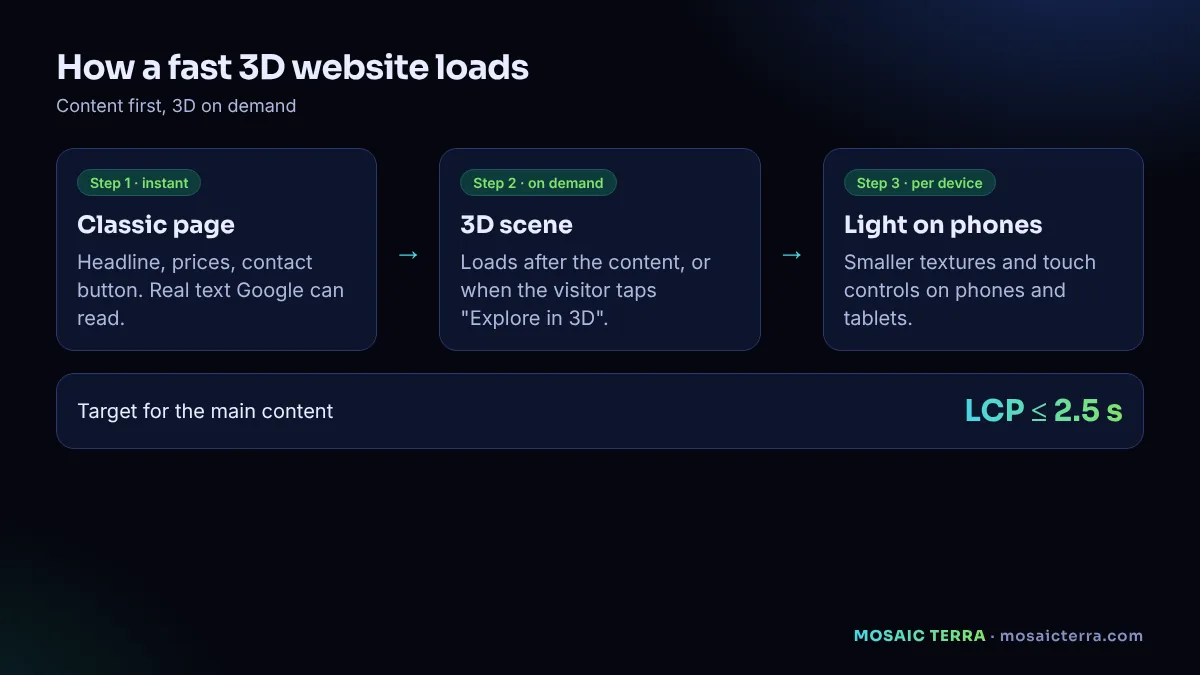
Good 3D websites are built in two layers:
- A fast, classic layer with your text, prices, contact details and buttons. This is what Google reads and what loads first on a phone.
- A 3D layer that adds the experience: the model, the walk-through, the scene. It should load after the important content, or only when the visitor chooses to open it.
If a 3D website makes visitors wait for a spinning loader before they can see your phone number, it has been built the wrong way round.
Examples of 3D on a small business website
- Your building in 3D. A café, gym, salon or shop modelled with its real logo and signs, so customers recognise it before they arrive.
- Product viewers. Furniture, jewellery, machinery or packaging that customers can rotate and zoom.
- Virtual showrooms and venues. Event spaces, holiday lets and offices that people can walk through.
- Maps and districts. A stylised map of your service area or a site plan for a development.
- Interactive brand worlds. A memorable experience that ties into your marketing and social media.
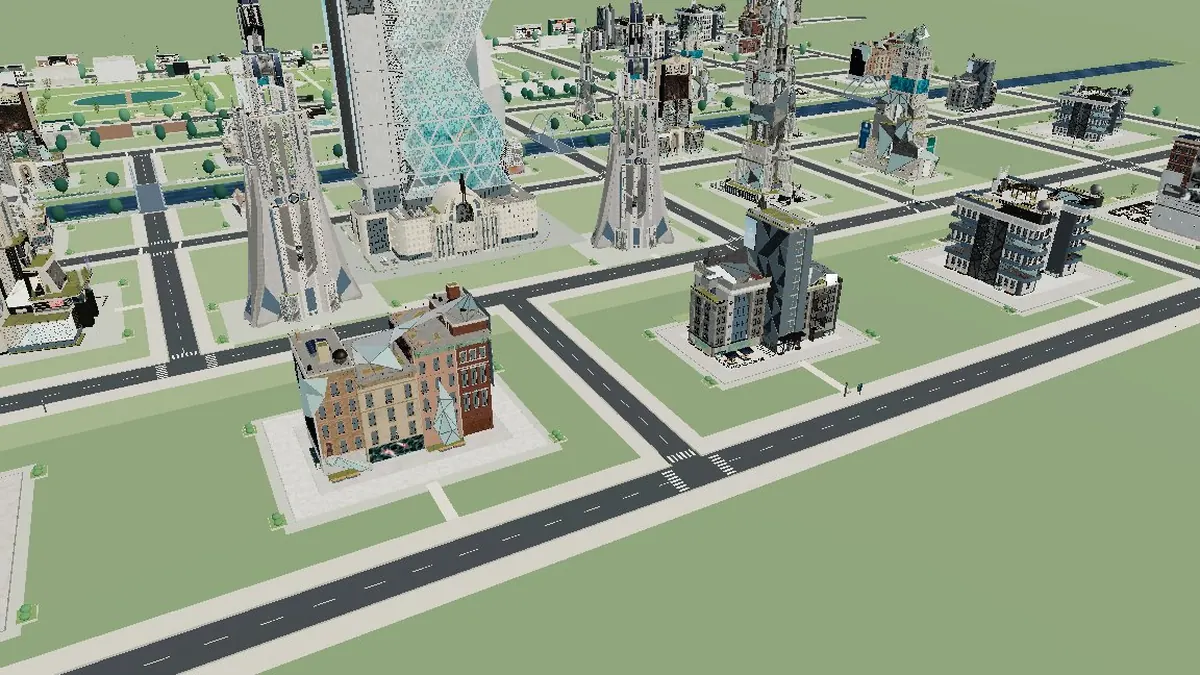
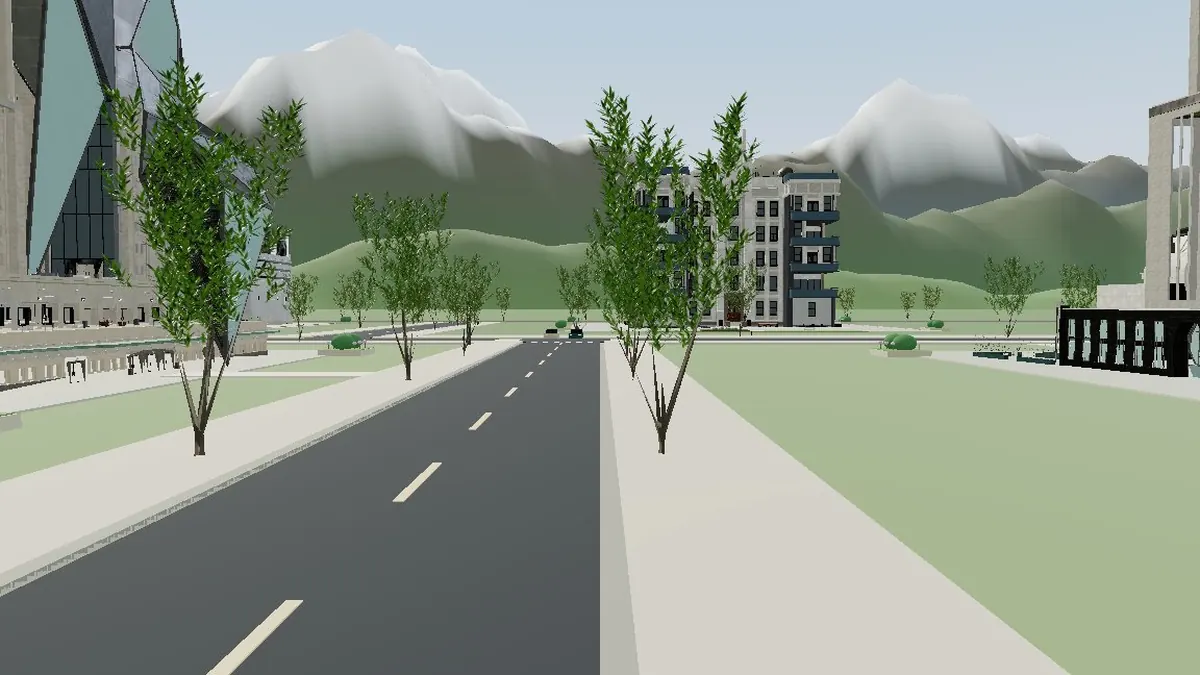
Our own city, world.mosaicterra.com, is a working example: a live 3D city where businesses have their own buildings, signs and AI agents. You can walk the streets, open buildings and see how a 3D presence feels in practice.
What does a 3D website cost?
The cost depends on three things: the number of 3D models, how detailed they are, and how much interaction you need. Rotating one product is simple. A walkable building with interiors, signs and animated people is a bigger job. Agencies that specialise in WebGL often quote per project, and complex experiences can take weeks.
At Mosaic Terra we have kept it simple:
| Option | What you get | Price |
|---|---|---|
| Your Website, Done For You | Classic or 3D design, domain and hosting for a year, mobile and Google-ready, contact form, Google Business Profile, live dashboard, daily reports, a year of maintenance and a digital space in our 3D world | £449 one-off (from year 2: £19/month) |
| Build with us · Your AI World | The complete package: your 3D world, 30 AI agents, website, domain, managed hosting, dashboard and daily reports | From £899, live within 7 days of scope approval |
| Build Your 3D World kit | PDF guide and starter files if you prefer to build it yourself | £9 once |
If you are comparing quotes, ask each provider how the 3D layer affects loading speed on a mid-range phone, and whether the classic content works without 3D at all.
Is a 3D website worth it? Five honest questions
1. Is your product or place visual?
If customers care how something looks, feels or is laid out (a venue, a property, a product, a showroom), 3D can answer questions that photos cannot. If you sell accountancy or plumbing, 3D is more about being memorable than about explaining the service.
2. Will it help people take action?
A 3D scene should lead somewhere: book a visit, request a quote, buy. Put clear buttons inside and beside the experience.
3. Does it still load fast on a phone?
Google's Web Vitals guidance treats a Largest Contentful Paint of 2.5 seconds or less as good (web.dev). Your main text and buttons should meet that even if the 3D scene loads later.
4. Can Google still read your content?
Search engines read text, not 3D scenes. Your services, prices, location and contact details need to be real HTML text on the page.
5. Who maintains it?
Browsers and devices change. A 3D experience needs occasional testing and updates, just like any other part of your site. Make sure maintenance is included or priced.
Common mistakes with 3D websites
- Loading everything at once. Huge models and textures that download before the visitor can do anything. The fix is progressive loading and lighter versions for phones.
- No fallback. If the 3D scene fails on an old device, visitors should still see your content and contact details.
- 3D instead of information. A beautiful scene with no prices, no phone number and no next step.
- Ignoring touch. Phone and tablet visitors need simple controls: drag, pinch and clear buttons.
- No accessibility. Provide text alternatives, keyboard navigation for key actions, and respect visitors who prefer reduced motion.
How we build 3D for small businesses
We start from the same foundations as any good website: fast pages, clear text, real prices and obvious buttons. Then we add the 3D layer where it earns its place, typically your building or space in our live 3D world, with your logo and signs. On phones and tablets we load a lighter version automatically so the experience stays smooth. You approve the design before anything goes live.
Because every package includes a digital space in our 3D world, you can start with a classic website and still have a 3D presence, then expand later if it brings results.
A quick decision checklist
- My product, venue or space is visual, or I want to be remembered.
- I have a clear action I want visitors to take.
- My main content loads fast on a phone without waiting for 3D.
- My services, prices and contact details are real text.
- Maintenance is included or priced.
If you ticked at least four, a 3D website is worth exploring. If not, start with a fast classic site and add 3D later. Either way, our guide to website costs in the UK will help you compare options fairly.
How a 3D project runs, step by step
If you have never commissioned 3D work, the process can feel mysterious. In practice it follows the same rhythm as any good website project, with one or two extra steps.
- Brief. What should visitors understand or feel? Which building, product or space should be shown? What should they do next?
- Reference material. Photos of your premises from several angles, your logo in good quality, colours and any signage. For products, clear photos or existing CAD files.
- Classic site first. Pages, text, prices and contact paths are built and checked on phones before any 3D work starts. This guarantees the site works even if someone never opens the 3D scene.
- 3D model and scene. The model is built at a sensible level of detail, textured with your branding and placed in a scene with lighting and camera paths.
- Performance pass. Textures are compressed, details reduced for distant objects and lighter versions prepared for phones and tablets.
- Review and approval. You test it on your own devices and ask for changes before anything goes live.
- Launch and measure. Track how many visitors open the 3D view, how long they stay and whether they click your main button afterwards.
Measuring whether 3D pays off
Treat 3D like any other marketing investment: decide in advance what success looks like. Useful signals include the share of visitors who open the 3D experience, the time they spend with it, and most importantly how many of them go on to contact you, book or buy. Compare these with visitors who never open the 3D view. If the 3D group converts better, expand it; if not, keep it as a memorable extra and focus your budget elsewhere.
Also watch the basics. If adding 3D makes your Core Web Vitals worse, fix that first; a beautiful experience that slows down your contact page is a bad trade. Our speed check guide shows you how to test this in ten minutes.
3D and accessibility
A good 3D website includes everyone. Every important action available in the 3D scene, such as contacting you or viewing a product, should also be available as a normal button or link. Provide short text descriptions of what the scene shows, make sure keyboard users can reach the main actions, and reduce motion for visitors who have asked their device to minimise animation. These steps also tend to help search engines understand your page.
See it before you decide
Walk around our live 3D city, then choose a classic or 3D website for the same price: £449 one-off, live within 3 days of receiving your content and approvals.
Frequently asked questions
What is a 3D website?
A normal website with an interactive three-dimensional scene inside it, such as a product viewer or a walkable building, running in the browser without any app.
Are 3D websites slow?
They do not have to be. Load the text and buttons first and the 3D scene on demand, with lighter versions for phones.
Can Google index a 3D website?
Google reads the text on the page, not the 3D scene, so services, prices and contact details must be real HTML text.
How much does a 3D website cost with Mosaic Terra?
Our website package is £449 one-off whether you choose a classic or 3D design. The complete Build with us package with your 3D world and 30 AI agents starts from £899.
Do 3D websites work on phones?
Yes, if they are built with lighter versions and touch controls for phones and tablets.
Sources
- three.js: JavaScript 3D library (official)
- web.dev: Web Vitals
- web.dev: Largest Contentful Paint (LCP)
Prices on this page are Mosaic Terra's own prices in GBP. Third-party information was checked on 29 October 2026; always confirm current details on the official pages.