
Guide · 29 October 2026 · 8 min read
How much does a website cost in the UK in 2026?
Ask five people what a website costs and you will hear five different numbers. That is not because anyone is lying. It is because "a website" can mean a one-page template you build on a Sunday afternoon, or a custom site with booking, payments and a content plan. This guide breaks the cost down the way a small UK business owner actually experiences it: what you pay to get started, what you keep paying every year, and which hidden costs turn a cheap website into an expensive one.
The short answer
For a small UK business in 2026 there are four realistic routes:
- Do it yourself with a website builder such as Wix, Squarespace or Shopify. You pay a monthly or yearly plan and you do the work. The plan prices are published on each provider's pricing page, and they change often, so always check the current figure before you decide.
- Hire a freelancer. Prices vary widely with experience, scope and location. A clear brief is the only way to get comparable quotes.
- Hire an agency. Usually the most expensive route, with project management, strategy and design teams included. Worth it for complex sites; often overkill for a five-page local business site.
- Buy a fixed-price, done-for-you package. You pay one known price and the provider handles design, setup, hosting and maintenance for an agreed period. This is the route we offer at Mosaic Terra: Your Website, Done For You is £449 one-off, live within 3 days of receiving your content and approvals.
The right choice depends less on the headline price and more on two questions: how much of your own time is the website worth, and what will it cost you over two or three years, not just in the first week?
What you are really paying for
Every website, whatever the route, is made of the same building blocks. When you compare quotes, check which of these are included and which are extras.
1. Domain name
Your address on the web, for example yourbusiness.co.uk. Domains renew every year. Some builders include a free domain for the first year only, so check the renewal price before you commit.
2. Hosting
The server that keeps your site online. With builders it is bundled into the plan. With freelancers and agencies it is often a separate monthly or yearly bill. Cheap hosting can be slow, and slow sites lose visitors (we explain how to test this in our 10-minute speed check).
3. Design and build
The work of turning your business into pages that look right on a phone, load fast and make it obvious how to contact you or buy. This is where quotes differ the most, because it is mostly time.
4. Content
Text, photos, prices, opening hours, service descriptions. Many projects stall here. If you have to write everything yourself, budget the hours. If the provider writes it, check whether that is included.
5. Search basics
Page titles, descriptions, a sitemap, fast loading, mobile layout and a Google Business Profile. These are not "advanced SEO"; they are the basics Google describes in its own Search Essentials. A website without them is much harder to find.
6. Maintenance
Updates, backups, security fixes, small text changes and someone to call when something breaks. This is the cost most people forget, and the one that decides whether the site still works in year two.
Year one versus year two: the cost people forget
Most website price comparisons stop at launch day. That is a mistake. A website is closer to a subscription than a purchase: the domain renews, hosting renews, and something always needs updating. When you compare options, write down three numbers for each:
- The upfront price.
- The yearly cost after the first year (domain, hosting, plan renewal, maintenance).
- Your own time, in hours, to build and keep it updated.
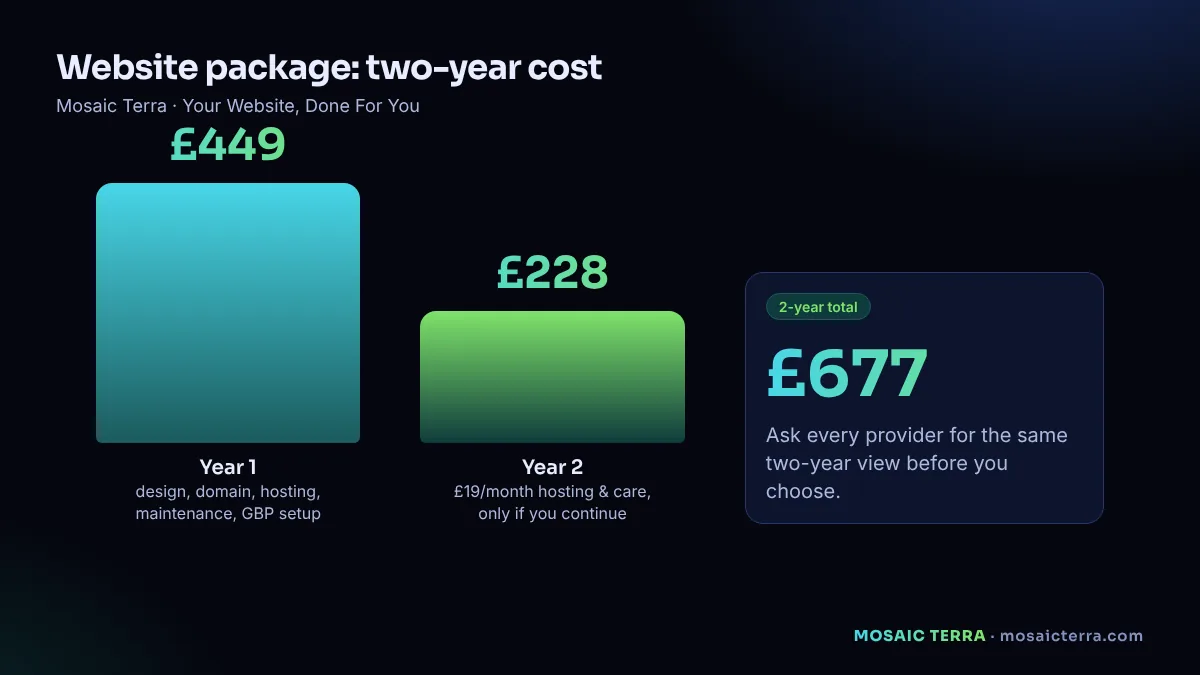
Here is how our own package works over two years, so you can see the structure clearly:
| Item | Year 1 | Year 2 |
|---|---|---|
| Design and build (classic or 3D) | Included in £449 | – |
| Domain and hosting | Included | £19/month (£228/year), only if you choose to continue |
| Maintenance and small changes | Included for 1 year | |
| Contact form and Google Business Profile setup | Included | – |
| Live dashboard, analytics and daily reports | Included | Included with hosting & care |
| Total | £449 | £228 |
Whatever provider you choose, ask for the same two-year view. If a quote cannot tell you what year two costs, that is a warning sign.
DIY builders: when they make sense
Website builders are genuinely good products. If you enjoy design, have a few spare evenings and need a simple site, a builder can be the cheapest route in cash terms. Look at the official Wix plans page or the equivalent for any other builder to see current prices and what each tier includes.
The trade-offs are time and skill. You choose the template, write the text, compress the images, set up the domain, connect your email, configure search settings and fix things when they break. For many owners the real cost is not the plan; it is the twenty or thirty hours they did not spend on customers. We compare the two routes in detail in Wix or a web designer?
Freelancers and agencies: how to get comparable quotes
Freelancer and agency prices vary so much because every project is scoped differently. To compare like with like, send everyone the same one-page brief:
- What your business does and who your customers are.
- The pages you need (home, services, about, contact, and so on).
- What visitors should do: call, book, buy, request a quote.
- Whether you will supply the text and photos, or need them written and sourced.
- Any integrations: booking systems, payments, newsletters, CRM.
- Who hosts the site, who owns the domain, and what maintenance is included.
Then ask each provider for a fixed price, a timeline and the year-two cost in writing. Make sure the domain is registered in your name, not the provider's.
Hidden costs that turn cheap into expensive
- Domain held by someone else. If your developer owns the domain, moving away later can be painful. Your domain should be yours.
- Paid plugins and apps. Booking widgets, forms and galleries often carry their own monthly fees.
- Slow hosting. A slow site costs you enquiries every day, quietly.
- No maintenance. Sites without updates break, get hacked or simply look abandoned.
- Change requests. Some providers charge for every small edit. Ask what is included.
- Missing legal details. If you trade as a limited company, GOV.UK guidance says your website must show your company's registered number, registered office address, where it is registered and that it is a limited company (GOV.UK). Fixing this later is easy, but forgetting it is common.
What does a good small business website need?
For most local and service businesses, a site that wins enquiries has the same core features:
- A clear headline that says what you do and where.
- Prices or "from" prices, where you can share them. People like to know the range before they call.
- A visible phone number, contact form or booking button on every page.
- Proof: photos of your work, real reviews, accreditations.
- Fast loading on a phone (under about 2.5 seconds for the main content is Google's "good" benchmark; see our speed check guide).
- A Google Business Profile that links to the site (see our 15-minute guide).
Anything beyond that, such as blogs, booking engines, online shops or 3D experiences, should earn its place by bringing in customers.
Is a 3D website more expensive?
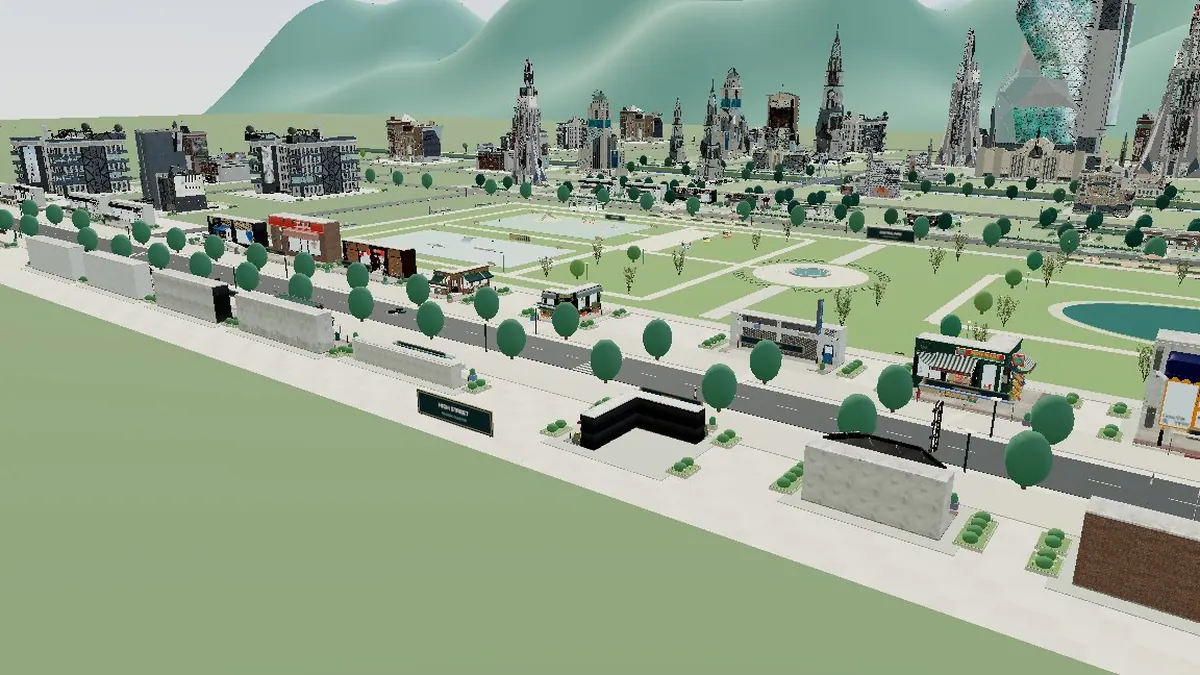
It can be, but it does not have to be. A 3D or interactive website is built with the same foundations as a classic site, with an extra visual layer on top. At Mosaic Terra the website package is the same £449 whether you choose a classic or 3D design, and every package includes a digital space in our live 3D world. If you are curious whether 3D is worth it for your business, read 3D websites for small businesses.
How to decide in ten minutes
- Write down how many hours you can honestly spend on the website this month.
- Decide whether you need payments, bookings or just enquiries.
- Get two or three written quotes using the same brief, including year-two costs.
- Check who owns the domain and the content.
- Pick the option with the clearest scope and the lowest two-year total for the result you need, not the lowest launch price.
Want it done for you?
Our website package is £449 one-off: custom design (classic or 3D), domain and hosting for a year, mobile and Google-ready setup, contact form, Google Business Profile, live dashboard, daily reports and a year of maintenance. Live within 3 days of receiving your content and approvals.
Frequently asked questions
How much does a basic small business website cost in the UK?
It depends on the route. Website builders charge a monthly or yearly plan and you do the work; freelancers and agencies quote per project. Our done-for-you website package is £449 one-off, with hosting and care from year two at £19/month if you choose to continue.
What are the yearly costs of a website?
Typically the domain renewal, hosting and maintenance. Always ask for the year-two cost in writing before you commit.
Should I own my domain name?
Yes. Register the domain in your own name or your company's name so you can move providers without losing your address.
How long does it take to build a small business website?
With a clear brief and ready content it can be days, not months. Our website package goes live within 3 days of receiving your content and approvals.
Does a limited company need anything special on its website?
GOV.UK guidance says a limited company's website must show its registered number, registered office address, where it is registered and that it is a limited company.
Sources
- Wix premium plan pricing (official)
- Google Search Central: Search Essentials
- GOV.UK: Running a limited company – signs, stationery and websites
Prices on this page are Mosaic Terra's own prices in GBP. Third-party information was checked on 29 October 2026; always confirm current details on the official pages.