Guide · 12 November 2026 · 4 min read
Choose a domain name for your small business
If you want to choose a domain name for your small business, keep it short, easy to say, and easy to spell. In most cases, the best choice is the one customers can remember after hearing it once. For UK businesses, the big decision is often .co.uk vs .com, plus whether the name is clear enough to use on your signage, invoices, Google profile and socials.
Choose a domain name that customers can remember
Start with the real-world test: can someone hear the name over the phone and type it correctly straight away? Short is usually better, but clarity matters more than being clever. Avoid hyphens if you can, skip numbers unless they are part of your brand, and keep the spelling plain. If you already use a business name, match the domain to that as closely as possible so people do not wonder whether they are in the right place.
If you are setting up a new site, our Your Website, Done For You package is the easiest way to go from domain to live website without juggling tech on your own.
.co.uk vs .com: which should you buy?
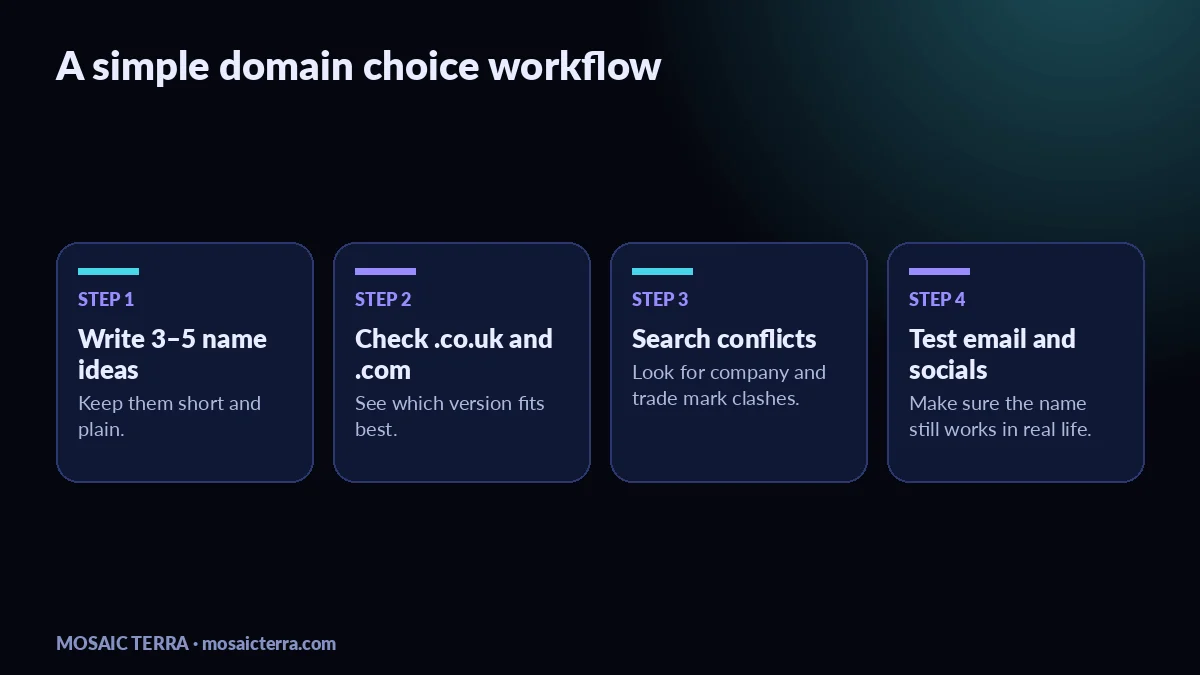
For a UK small business, .co.uk often feels most natural because it signals that you are local and makes sense to British customers. A .com can be useful if you serve customers outside the UK, want a more international feel, or the .co.uk version is gone. If your name matters, the safest move is often to buy both if you can and point one to the other, so nobody else uses a similar address.
There is no rule that says one extension is always better. We usually tell clients to choose the version that matches how they sell, then check whether the social handles, Google Business Profile name and email address still look consistent.
When .co.uk is usually the better fit
- You mainly sell to UK customers.
- You want the business to feel local from the start.
- Your brand name already sounds UK-based.
When .com may be the better fit
- You plan to sell beyond the UK.
- Your brand could grow into other markets.
- The .co.uk version is confusing or unavailable.
Checks before you buy a domain name
Before you pay, do a few quick checks. First, read the name out loud and ask: does it sound like something a customer would remember? Second, search the name on GOV.UK guidance on choosing a company name and check for obvious clashes. Third, look at GOV.UK’s trade mark search guidance so you do not build a brand around a name that is already protected. If you want the technical side to stay clean, web.dev explains why HTTPS matters once your site is live.
Also check how the domain looks in email, because a name can be fine on a website but awkward in an inbox. Try it as hello@yourdomain.co.uk and see whether it still looks professional. If you are in a hurry, our quote page is the quickest way to ask us to handle the domain, website and setup for you.
If you want a ready-made starting point, our Build Your 3D World kit is useful for testing ideas, but for most local businesses the domain decision should come first.
A simple step-by-step way to decide
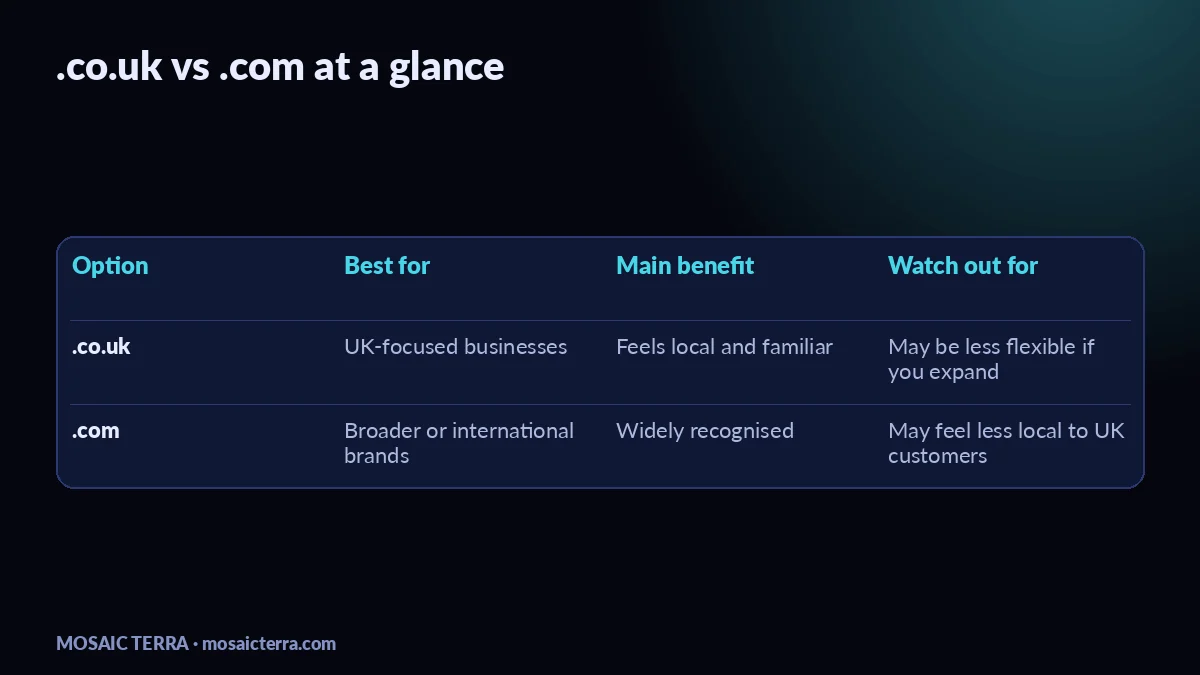
- Write down 3 to 5 name ideas.
- Say each one out loud and spell it out slowly.
- Check the .co.uk and .com versions.
- Search for business-name and trade-mark conflicts.
- Test how the name looks in an email address.
- Pick the version that is easiest for customers.
If you want inspiration for the rest of your online setup, our guides on one page website for sole traders and Google Business Profile show how your domain, website and local listing should work together.
Common mistakes when choosing a domain
- Using a name that is hard to spell after hearing it once.
- Adding hyphens or numbers for no good reason.
- Picking a domain that is too narrow if you may expand later.
- Buying only one extension and leaving the other open.
- Forgetting to test the name in email addresses and social profiles.
One practical shortcut if you are doing this yourself is to sketch your options on paper first, then check the domain before you design a logo or print cards. If you want a simple planning aid while you sort your brand, we also have a shop at mosaicterra.etsy.com.
When to get help
Get help if the name is close to an existing business, if you are unsure about trademark risk, or if you want the domain, website, email and hosting set up properly in one go. That is often cheaper in time and stress than buying the wrong domain first and redoing everything later. If you are ready to move, our website package is built for small businesses that want a straightforward launch.
For more context on your wider setup, see our guides on website costs in the UK and the online checklist after registering a limited company.
The best domain is not the fanciest one. It is the one customers can remember, trust and type without thinking.
Prefer it done for you?
Websites from £449 one-off, an AI Receptionist for £49/month, AI agents from £89/month, or your complete AI world from £899.
Frequently asked questions
Should I choose .co.uk or .com?
If you mainly sell in the UK, .co.uk is often the clearest choice. If you serve outside the UK or want a more international feel, .com can make sense too.
How long should a domain name be?
As short as you can make it while staying clear. If people struggle to spell or say it, it is probably too long.
Should I put hyphens in my domain name?
Usually no. Hyphens make domains harder to say, remember and type, so they are best avoided unless you have a strong reason.
What should I check before buying a domain?
Check spelling, trade mark conflicts, company-name clashes, and how the name looks as an email address.
Sources
Prices on this page are Mosaic Terra's own prices in GBP. Third-party information was checked on 12 November 2026; always confirm current details on the official pages.