

Guide · 29 October 2026 · 7 min read
Wix or a web designer? When it's worth paying in the UK
Website builders like Wix, Squarespace and Shopify have made it possible for anyone to put a site online in an afternoon. So why would a small business pay a web designer at all? Sometimes it should not. Sometimes paying is the cheapest decision it will make all year. This guide helps you work out which one you are.
The real question is not price, it is time
A website builder's plan is usually cheaper in cash than hiring someone. Current plan prices are published on each builder's pricing page, for example the official Wix plans page. But the plan is only part of the cost. You also pay with your time: choosing a template, writing every page, editing photos, connecting a domain and email, setting up forms, learning search settings and fixing things when they break.
A useful way to compare is to put a value on your hours. If an hour of your time is worth £30 to your business and a DIY site takes you 25 hours to do well, that is £750 of your time before the plan fee. If you enjoy it and have quiet evenings, that may be fine. If those hours would have gone on paying customers, it is not.
When a DIY builder is the right choice
- You are testing an idea and might change direction soon.
- You need a very simple one or two page site.
- You enjoy design and writing, and have the time.
- Your customers mostly find you through word of mouth, so search matters less.
- Your budget is genuinely close to zero this month.
Builders are reliable, secure and improving every year. Choosing one is not a mistake. Choosing one and then never finishing the site is.
When paying a web designer is worth it
- Your time is better spent with customers.
- You rely on Google and local search to bring enquiries.
- You need things to work properly: booking, quotes, payments, integrations.
- You want the site to look clearly better than competitors'.
- You want someone responsible for keeping it updated, backed up and secure.
A good designer is not only making it pretty. They are deciding what goes on the first screen, making the contact path obvious, writing page titles that match what people search, and making it load fast on a phone. Those details are what turn visitors into enquiries.
Side-by-side comparison
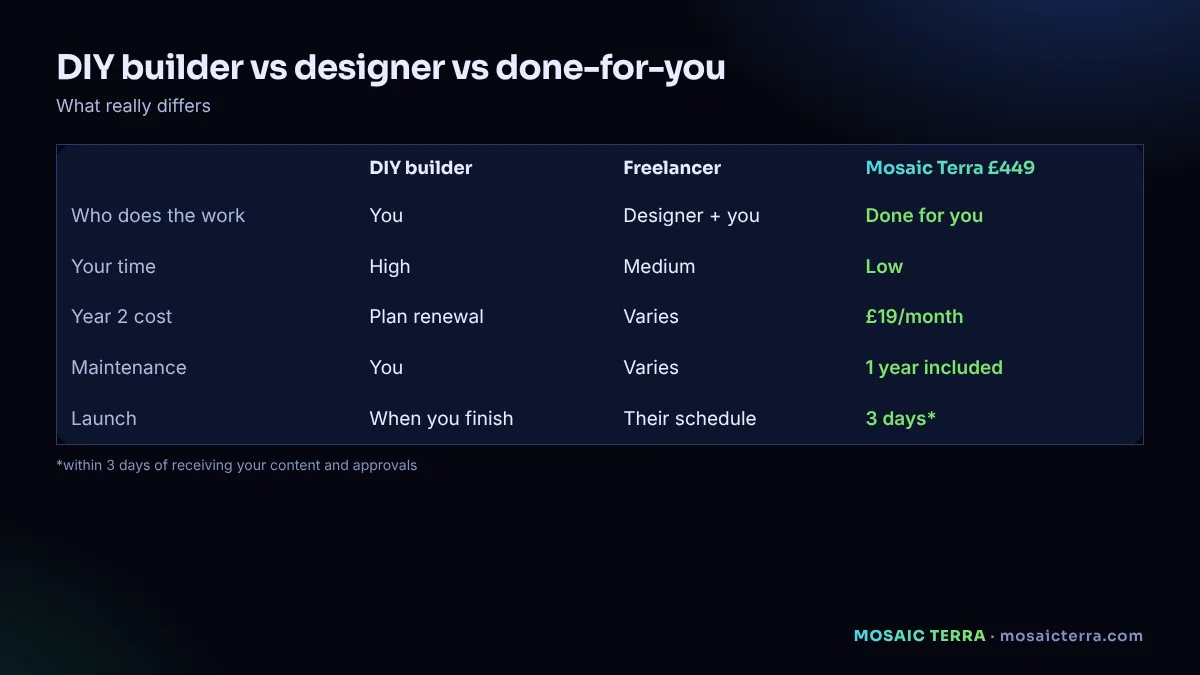
| DIY builder | Freelance designer | Done-for-you package (Mosaic Terra) | |
|---|---|---|---|
| Who does the work | You | The designer, with your input | We do, with your approval |
| Your time | High | Medium (briefing, feedback) | Low (content and approvals) |
| Upfront cost | Plan fee | Quoted per project | £449 one-off |
| Year 2 | Plan renewal | Hosting and maintenance, if offered | £19/month hosting & care, only if you continue |
| Speed to launch | When you finish | Depends on schedule | Within 3 days of content and approvals |
| Maintenance | You | Varies | Included for 1 year |
| Google Business Profile | You | Sometimes | Included |
| 3D option | Limited | Specialist work | Same price, classic or 3D |
What about search (SEO)?
Both routes can rank on Google. Google does not prefer builders or hand-built sites; it prefers pages that are useful, fast and clear about what they offer. Its own Search Essentials are the best starting point. What tends to differ is execution:
- Page titles and descriptions that match real searches, such as "boiler service Witney", not "Home".
- Speed. Heavy templates with large images and many apps can be slow on phones. Google's "good" benchmark for loading the main content is 2.5 seconds or less (web.dev). Our speed check guide shows how to test yours.
- Local signals. A complete Google Business Profile, consistent address and phone number, and real reviews.
- Useful content. Answers to the questions your customers actually ask.
Five questions to ask any web designer
- Who owns the domain and the website files? The answer should be: you.
- What does year two cost? Get it in writing.
- How fast will it load on a mid-range phone? Ask them to show a speed test of a site they built.
- What is included in maintenance? Updates, backups, small text changes?
- Can I see live sites you built, and talk to one client? Real work beats a portfolio of mock-ups.
Red flags
- No written price or timeline.
- The domain registered in the designer's name.
- Promises of "page one of Google guaranteed". Nobody can guarantee rankings.
- No mobile preview before launch.
- Extra charges for every small change, not mentioned upfront.
A middle way: start simple, upgrade later
You do not have to choose forever. Many businesses start with a DIY site, learn what customers ask for, then move to a designed site once the business has proved itself. If you go that way, keep your domain in your own name from day one, and keep your text and photos in a folder you control, so moving later is easy.
If you would rather skip the DIY phase, our website cost guide explains exactly what a done-for-you package should include.
Our honest recommendation
If you have more time than money and a simple offer, use a builder and finish it properly this week. If you have more customers than time, or you depend on Google for new business, pay for a well-built site with clear year-two costs. Either way, the worst website is the one that never goes live.
A realistic DIY timeline
If you decide to build the site yourself, plan it like a project rather than "one weekend". A realistic timeline for a five-page site looks like this:
- Week 1: choose the builder and template, register the domain in your name, collect your photos and logo.
- Week 2: write the text for each page. This takes longer than most people expect; aim for clear and specific, not long.
- Week 3: build the pages, add the contact form, connect your domain and email, test on your phone.
- Week 4: set page titles and descriptions, create your Google Business Profile, run a speed test, ask a friend to try to contact you through the site.
Following a plan like this is the difference between a DIY site that brings in enquiries and one that sits unfinished.
How to brief a designer so you get a great result
Whether you hire a freelancer or a package like ours, a short, clear brief saves time and money. Include:
- Three websites you like and why (layout, tone, colours).
- Your top three services and the one you most want to sell.
- Your ideal customer and the questions they always ask.
- Your logo, photos and any brand colours.
- What success looks like in three months: calls, bookings, quote requests.
Good designers will challenge your brief and suggest improvements. That conversation is part of what you are paying for.
What happens when you need changes later?
With a DIY builder you make changes yourself whenever you like. With a designer, ask before you start how changes work: are small text edits included, how quickly are they done, and what counts as a bigger change? With our package, maintenance and small changes are included for the first year, and you can continue with hosting and care at £19/month from year two if you wish.
Ownership checklist, whichever route you choose
- The domain is registered in your name or your company's name, with login details you hold.
- You have admin access to the website, the hosting and the analytics.
- Your business email works independently of the person who built the site.
- You have a copy of your text, photos and logo outside the website.
- You know how to cancel or move the site if you ever need to.
Getting these right at the start costs nothing and protects you whatever happens later.
A simple way to decide
Write down three numbers: the hours you expect to spend building and maintaining a DIY site in the first year, what an hour of your time is worth to your business, and the cost of the professional option you are considering. If your hours multiplied by your hourly value are close to or above the professional price, paying for help usually makes sense. If you enjoy building and have the time, DIY is a perfectly good choice. Either way, the decision should rest on your numbers, not on someone else's sales pitch.
Skip the DIY weekends
Your website done for you: classic or 3D, domain and hosting for a year, Google Business Profile, a year of maintenance. £449 one-off, live within 3 days of receiving your content and approvals.
Frequently asked questions
Is Wix good enough for a small business?
Yes, for many simple sites. The main costs are your time to build and maintain it properly, plus the plan fee.
Do designed websites rank better on Google than Wix?
Not automatically. Google rewards useful, fast, clear pages; execution matters more than the platform.
How much does a web designer cost in the UK?
Quotes vary with scope. Our done-for-you website package is £449 one-off, with £19/month hosting and care from year two if you continue.
Who should own my domain?
You should. Make sure it is registered in your or your company's name.
Can I move from Wix to a designed site later?
Yes. Keep your domain in your name and your content in a folder you control to make moving easy.
Sources
Prices on this page are Mosaic Terra's own prices in GBP. Third-party information was checked on 29 October 2026; always confirm current details on the official pages.