
Guide · 9 November 2026 · 4 min read
Privacy policy small business UK: a plain-English guide
If you need a privacy policy small business uk owners can actually use, start with official guidance and keep it simple. Your policy should explain what personal data you collect, why you collect it, who you share it with, how long you keep it, and what rights people have. For most small websites, that means a short, clear notice written for real customers, not lawyers.
What a privacy policy should cover
The safest approach is to describe your own website and systems, not copy another site word for word. If you use contact forms, newsletter sign-ups, analytics, embedded maps, booking tools or payment processors, mention each one plainly. The government’s data protection guidance is a useful public-facing starting point, and web.dev’s privacy learning path explains how common website features affect user privacy in plain language.
As a rule, your policy should answer these questions:
- Who you are and how people can contact you
- What personal data you collect
- Why you use it and your lawful basis
- Whether you share it with third parties
- How long you keep it
- What rights people have under UK data protection law
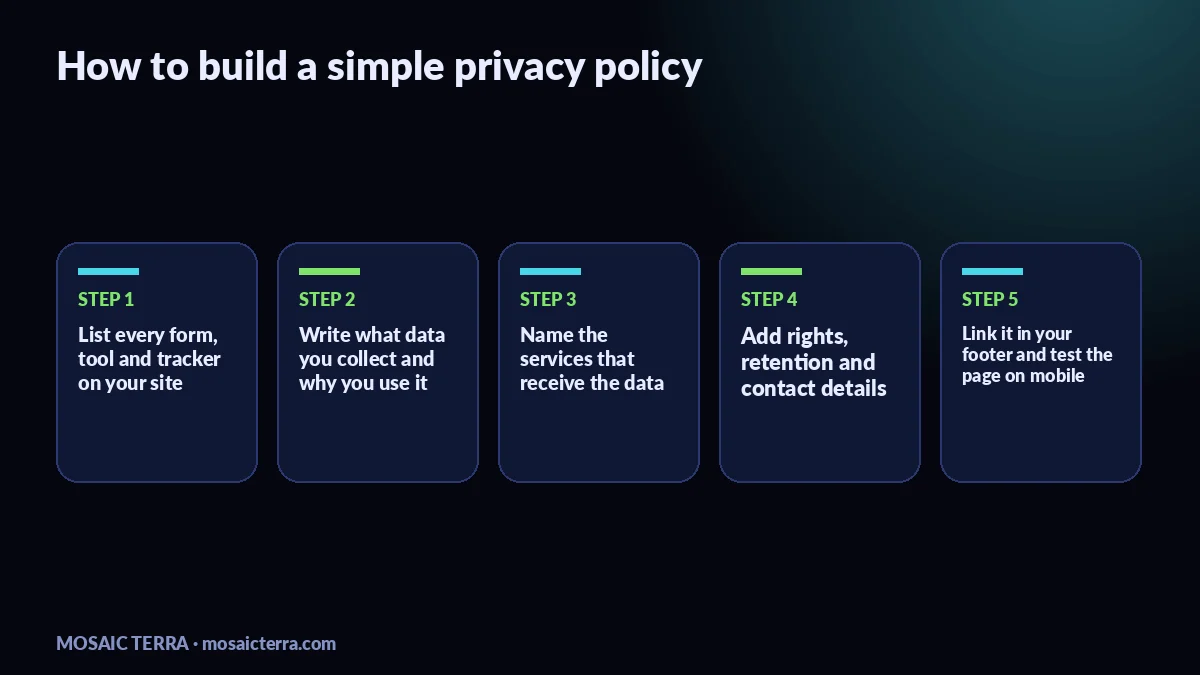
privacy policy small business uk: a simple structure
For a small website, use a structure that mirrors how people browse. Keep each section short. If you run a salon, café, trades business or local service, your policy can usually stay on one page as long as it is complete.
- Who we are — your business name, address or trading name, and contact details.
- What we collect — form submissions, booking details, email addresses, phone numbers, payment information, cookies, analytics, and support messages.
- Why we collect it — to reply to enquiries, manage bookings, provide services, send updates, or improve the website.
- Who we share it with — for example, your hosting provider, email provider, booking system, payment provider, or analytics tools.
- How long we keep it — give a sensible retention period, or explain how you decide it.
- Your rights — access, correction, deletion, objection, restriction, and complaint rights.
If you want a ready-made shortcut for building the page itself, our Your Website, Done For You package can include the kind of clear site structure that makes policies easier to place and keep updated.
How to write it without overcomplicating it
Write in the first person plural, use short sentences, and avoid legal filler. Say “we use your email address to reply to your enquiry” instead of vague phrases like “for legitimate business purposes.” If you use analytics or advertising cookies, make sure your cookie banner and policy match. The government’s guidance on data protection and the Google Search Central guidance on helpful content are both useful reminders to keep your wording accurate, user-focused, and easy to scan.
Also make the policy easy to find. Put a link in your footer, on your contact page, and near any form that collects personal data. If your site is built with forms, booking tools or email automations, this is one of the first things we check when we plan a small-business website or an AI receptionist for small businesses.
If you prefer a DIY shortcut, the closest fit in our Etsy shop is One Page Website Template, Mobile Friendly, 4 Colour Themes, Easy Edit, Instant Download, which can help you organise a simple site before you tailor your policy.
Common mistakes to avoid
Most small business privacy policies go wrong because they are copied, outdated, or too vague. These are the mistakes we see most often:
- Copying a bigger company’s policy and leaving in tools you do not use
- Forgetting to name third-party services like email, payment or booking providers
- Leaving out cookie use or analytics
- Using legal language that customers cannot follow
- Not updating the policy after adding a new form, chat tool, or newsletter signup
If your site is changing at the same time as your business, our guide to just registered a limited company? can help you keep the basics tidy, and our Google Business Profile guide is useful for keeping your online details consistent across channels.
When to get help
You do not need a solicitor for every small website, but you should get help if you collect sensitive data, sell online, use complex tracking, or serve children. It is also worth getting support if you are unsure which lawful basis fits your processing or if your forms feed into lots of automations. For a practical website setup, check our quote page or browse all offers if you want help turning a rough draft into a live site.
Remember: this article is general information, not legal advice. If you are unsure, read the official guidance directly and update your policy whenever your website changes.
| Section | What to include | Why it matters |
|---|---|---|
| Who we are | Business name and contact details | So people know who controls their data |
| Data collected | Forms, bookings, emails, cookies | So the policy matches the site |
| Use and sharing | Purpose and third parties | So users understand what happens to their data |
| Rights and retention | How long you keep data and rights | So users know what they can ask for |
Prefer it done for you?
Websites from £449 one-off, an AI Receptionist for £49/month, AI agents from £89/month, or your complete AI world from £899.
Frequently asked questions
Do I need a privacy policy on a small business website?
Yes, if your site collects personal data, even from a simple contact form or newsletter signup.
Can I copy another company’s privacy policy?
No. You should write one that matches your own site, tools and data use.
Where should I put the privacy policy?
Link it in your footer and near any form that collects personal data.
Do I need a lawyer to write it?
Not always, but get legal help if your data use is complex or sensitive.
Sources
- GOV.UK: data protection
- web.dev: privacy learning path
- Google Search Central: creating helpful content
Prices on this page are Mosaic Terra's own prices in GBP. Third-party information was checked on 9 November 2026; always confirm current details on the official pages.